Uganda
Africa on a phototrip is a whirlwind experience from sunup to sundown. I joined my husband, an African wildlife photographer, and other photographers on safari in Kenya. At the end we flew to Uganda for an experience very different from anything we have done before: hiking in to see the Mountain Gorillas.
With this next adventure, my mind started racing with a lot of questions. How close will I get to them? Will I feel safe around such powerful creatures? How hard will the hike be?
Then the biggest question of all; Will we actually find them? There are no guarantees when you are dealing with nature so this could either be the biggest waste of money or an amazing experience. I’m hoping for the latter.
Why Mountain Gorillas Needed Protection
With all this in mind, I started looking up information on the gorillas and was fascinated by what I found. By the early 1980s, the population of mountain gorillas had fallen to roughly 250. But with decades of intense, successful conservation, there are hundreds more gorillas in existence. Uganda played a big part in this by taking steps to protect Bwindi’s Impenetrable Forest and the many species that depended on it. To help with conservation, In 1991, Bwindi Impenetrable Forest was designated a national park, giving the forest stronger protection against agricultural expansion and habitat loss. For the mountain gorillas living there, protecting their habitat was an important part of their conservation.
This national park was ideal for the gorillas because it gave them a secure space but not so good for the growing human population. As families grew the farmers needed more space for farmland, so they cleared some of the forest to make room for their crops so they could support their families.
For the gorillas, droughts and seasonal shifts cause bamboo and natural food sources to become less available causing them to go outside the park and into farmers’ fields where they found high-calorie food such as bananas, maize and plantains. As the gorillas feast, the farmers lost their crops and their livelihood. This created resentment toward the gorillas and the park. To protect their crops some farmers took matters into their own hands creating a new threat to the gorillas. This put the gorillas in danger conservationists hadn’t planned on.
How Gorilla Tourism Helps Local Communities
To address this problem, Conservationists realized local communities needed to benefit from protecting the gorillas. One solution was hiring local people as porters to carrying visitor’s gear on gorilla treks. Porters receive a minimum of $20 in tips but many tourists pay more. For farmers who live on about $2 a day, the money can help families through lean seasons, buy seeds, tools and livestock or pay for hired labor. Those in the rotation have an opportunity to work twice a month. By giving local people an economic stake in gorilla tourism, these jobs have helped build community support for conservation.
Another source of revenue is the gorilla trekking permit. For a foreign non-resident it is $800 per day. This money is used for park operations and tourism management. $10 from each permit goes to help the community develop schools, health facilities, water systems and roads. Uganda Wildlife Authority also shares 20% of its annual revenue with the surrounding communities.
Knowing all of this before our trek changed the way I looked at the experience. We were not only paying for the privilege of seeing the gorillas, we were participating in a much larger conservation effort- one that is trying to protect the gorillas and give the people who live alongside them an economic reason to protect them too.
Getting to the lodge was slow and bumpy. The clouds were thick and ominous as rain threatened our adventure. We drove on dirt roads passing through many villages until we came to a really steep hill. At the top of this rocky, rugged road was our lodging. The truck tipped side to side as it drove over rocks and old tire grooves. Deep tire grooves in the mud showed where other trucks had struggled their way to the top. We finally made it to the top of the hill before it started pouring rain. Opposite the hotel was a view of a mountain with mist across the middle. I couldn’t help but wonder if that was where the gorillas lived.
The next morning we began our trek into the park.
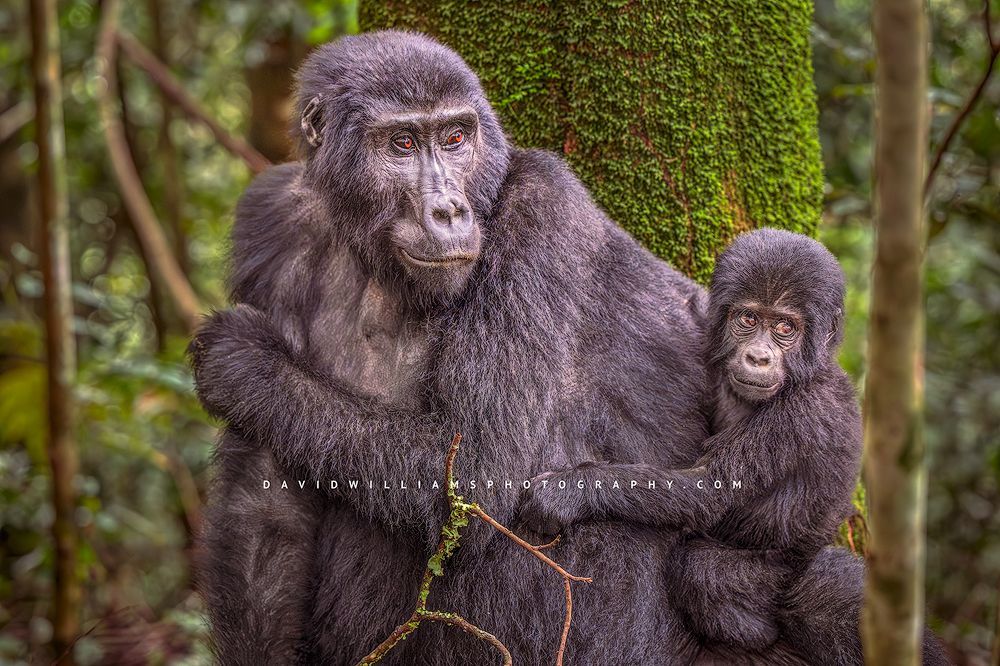
We had been hiking through the forest for an hour when we heard a rustling above us followed by the sharp crack and breaking of branches. We all stopped and looked toward the sound. Leaves were falling from the trees. Then we saw them. Three gorillas were making their way down through the branches. They moved effortlessly, eating leaves with one hand while hanging onto a limb with the other. One was a mother with a baby clinging to her back.
The photographers immediately scrambled for their cameras, stumbling and moving awkwardly through the thick bushes as they tried to find a clear view. It was a clumsy scene. The gorillas were anything but. They moved through the vegetation as though it wasn’t even there.
As we followed them searching for the best angle, we eventually came to a clearing. One by one the guides motioned for each of us to sit down, stay low and remain quiet.
Ten feet in front of us sat a mother gorilla with her baby.
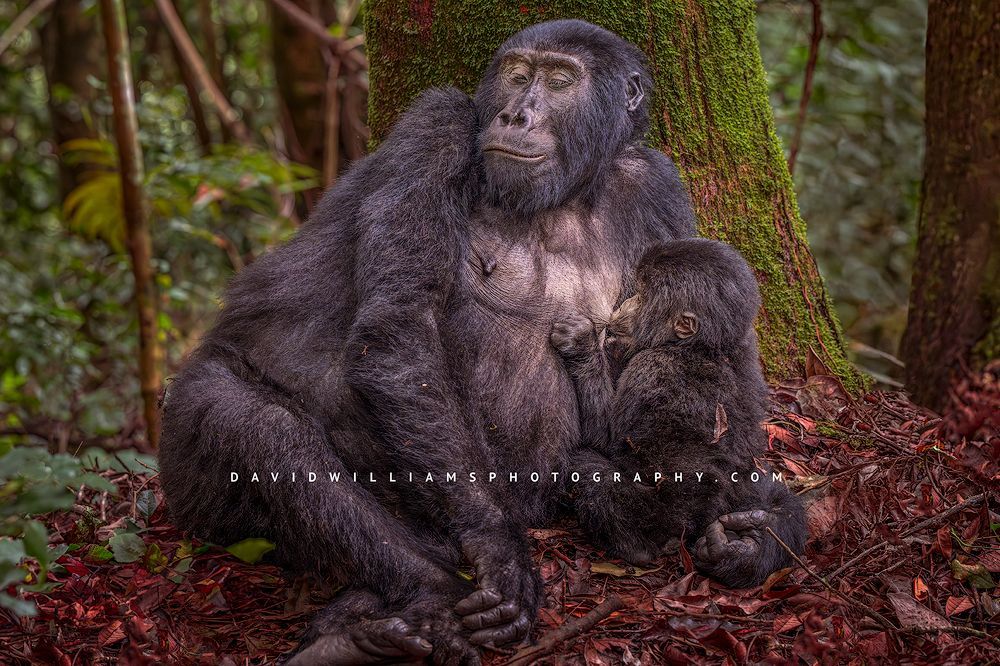
The baby was nursing. When it finished, it climbed around on its mom then settled peacefully in her arms. For the next hour we simply watched. There was something mesmerizing about the quiet interaction between mother and baby. No posing. No performing. Just a mother caring for her young, completely at ease with us sitting nearby.
Then we heard it.
A deep, powerful and loud grunt broke the silence. I looked up and saw a large silverback walking toward us. He grunted again, looking in our direction. His grunt was a call to his family that it was time to move on. Then his eyes shifted to the mom and baby. He kept coming. My heart started pounding. I stayed completely still as he moved closer and closer. Soon he was only a few feet away from me. For a moment I wasn’t sure what he was going to do. Then, just as quickly as he had appeared he disappeared into the thick bush. The other gorillas followed.
For a moment, none of us moved.
What could possibly be better than this? The answer was simple. Nothing.
Before the trek I had wondered whether we would even find the gorillas and whether the experience could possibly be worth what we had paid. Now I had my answer.
It was worth every penny.
After everything we had seen and experienced in Africa, there could have been no better way to end our safari than sitting quietly in a Ugandan forest, watching a family of mountain gorillas go about their lives.


Leave a Reply