Tanzania
Rain is good in moderation. Too much of it can make familiar roads impassable and too little can leave the landscape and animals thirsty. This year the rain came in abundance, transforming the dusty landscape into a lush sea of green and creating driving conditions none of us expected.
Before we arrived in Kenya the rainy season was in full swing. It had rained everyday for weeks and continued most afternoons once we arrived. Several nights in a row we could hear rain pouring down on our mobile tent. With so much rain, the ground became saturated creating unpredictable driving conditions.
Our group of twelve was divided among four vehicles. Each driver had 20 plus years of driving experience. At first the muddy roads added to the adventure as we slid around in a 4-wheeling experience. But as the rains continued, the puddles became deeper and the roads remained saturated and slick. Between the four trucks we got stuck over ten times. Soon, we stopped counting. The drivers told us in all their years of driving they hadn’t experienced this much rain. They found themselves “learning on the job”, working together to pull one vehicle after another out of the mud. One truck got so bogged down in soggy grass we wondered if it would ever make it out.
On our way into the Serengeti we stopped at the gift shop at Naabi Gate to get a few souvenirs and use the facilities. I noticed we were spending more time than usual there. Our guide and drivers were standing around waiting and talking. Finally, we were told to load up. We hadn’t gone far when we came to an abrupt stop. Now I know why the drivers stalled so long. A line of trucks stretched ahead of us. Curious, we climbed out and went with our guide to see what had stopped everyone.
The answer made us gasp.
The road had disappeared.
No Way Forward
Hundreds of vehicles were stopped on both sides with more coming every few minutes. Drivers and passengers stood along the bank, all wondering the same thing.
Would the water eventually go down?
I looked down and immediately knew the answer. A stream was pouring into the crossing, feeding the flood faster than it could drain away.
Not any time soon.
Now what do we do? I glanced at my watch. It was 1:00 in the afternoon. Would we have to sleep in our truck? We had no blankets. We had no lunch, dinner, or breakfast. Then there was the bathroom situation. With lions nearby and very few trees to hide behind, privacy wasn’t exactly an option.
Just hours earlier, we had been looking forward to another exciting day on safari anticipating what we would see next. Now, we were stranded in the middle of the Serengeti with no clear way forward and no hint of when our situation might change.
So we waited. What did we do? We talked to people, watched kids playing in a stream, photographed lions eating a fresh kill nearby, listened to hippos snorting in a nearby watering hole and waited some more.
A Possible Way Out
As we waited, I watched a Caterpillar inch through the churning water, its massive tires nearly disappearing beneath the current as he was trying to divert the water.
Then Charles, our guide, came up with an idea.
He arranged to have the Caterpillar shuttle our group to the other side and then another vehicle could take us to our lodging. It sounded like the perfect solution.
Four from our group climbed aboard with Charles and made it across. We were relieved that someone had made it to the other side. However, instead of climbing off, they remained on and we watched as the crowd waiting on the opposite bank tightened around the machine. Only later did we learn what had happened. People waiting on the opposite bank were furious that the Caterpillar was being used as a shuttle rather than a tool to clear the flooding so everyone could continue. They threatened to beat up the driver if he shuttled more people across. It was a fair point. Hundreds of people were stranded. Not just us. When the driver agreed to stop the shuttle service the mob let the people climb down.
Our perfect solution was gone.
While we waited one truck pulled out of line and eased into the water and slowly started to cross. Every eye followed as it crawled into the muddy current. The water climbed to the bottom of his doors until the tires disappeared completely. Half way across the truck stopped. Then it began tipping towards the driver’s side. Was he going to continue tipping? We watched in disbelief. Fortunately, a nearby tractor intervened and pulled the truck back to dry land where locals got under the hood and helped fix it. Water sprayed out each time they tried to start it. Finally, the engine came to life. And then, unbelievably, the driver tried again. The truck made it about as far as it had the first time before stopping again. This time the Caterpillar moved into position, hooked onto it and towed it the rest of the way. Moments later the truck disappeared down the road as if nothing happened. We just stood there shaking our heads.
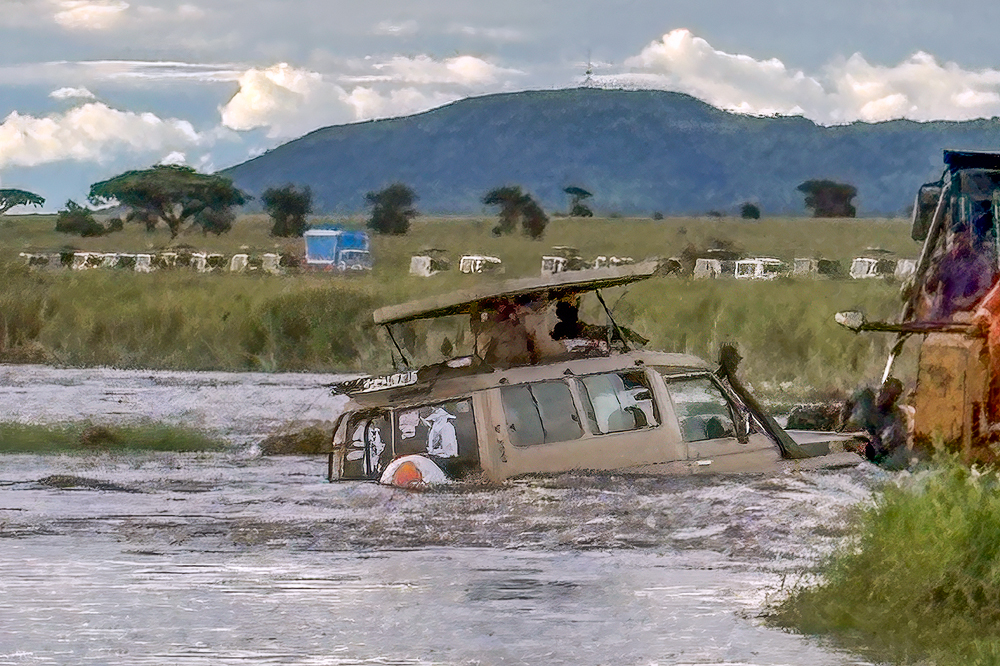
At 6:00 p.m. our drivers decided our best option was to turn left across the shallower edge of the flooding and take the long way to our lodge. It felt like we were going into uncharted territory but we were moving again. Would the roads be passable? What would we find in the darkness ahead?
Into The Unknown
Just after we turned, we encountered our first obstacle.
It was a large pool of water with more water rushing in from the side. How deep and muddy was it? We watched the vehicles ahead go through it and saw their tires disappear. That was pretty deep. Cautiously, we eased into the water and luckily made it through. As we drove further the uneven, muddy roads jolted us around like a wild ride at an amusement park. Darkness was settling in, making it harder to see what lay ahead.
Then we heard a grinding noise from beneath our vehicle. Our driver immediately pulled off to the side of the road and climbed out to take a look. After a few tense minutes, he delivered the dreaded news.
Our truck had broken down and would have to be left behind.
We quickly gathered our things and loaded them into another truck in our group We had to make sure we had everything because we weren’t coming back.
It was dark and we had been shaken on bumpy roads for 2 ½ hours. We were finally nearing the turnoff to the main road and were very relieved that the end was in sight. Then we hit another large breadth of mud. One truck got stuck in the middle. The drivers jumped out of their vehicles and used cell phone lights and headlights to assess the situation. Our truck backed up and hooked a tow cable, but as we strained to pull the other vehicle out, the cable snapped. The drivers tied the two ends together and tried again. Success.
We were so close to our lodge but one last river stood in our way. The crossing seemed to go on forever. As we drove, I couldn’t believe how much water surrounded us. Finally, lights appeared in the distance- our camp. When we arrived, those who had arrived earlier were there to greet us. After such a long day we were more than ready to leave the bumpy road behind, and enjoy a warm meal, a warm shower, and, most of all, a bed.
In Their World
As our trip came to an end, I realized we had been visitors in the animals’ domain. The relentless rains had disrupted our plans, stranded our vehicles and left us feeling completely out of our element. Meanwhile, the animals were completely unaffected. The flooded plains brought plenty of fresh water and a feast of new greens.
We left Africa with a deeper respect for the power of nature—and gratitude for an adventure we will never forget. Africa didn’t change to accommodate us—we had to adapt to Africa.


Leave a Reply